
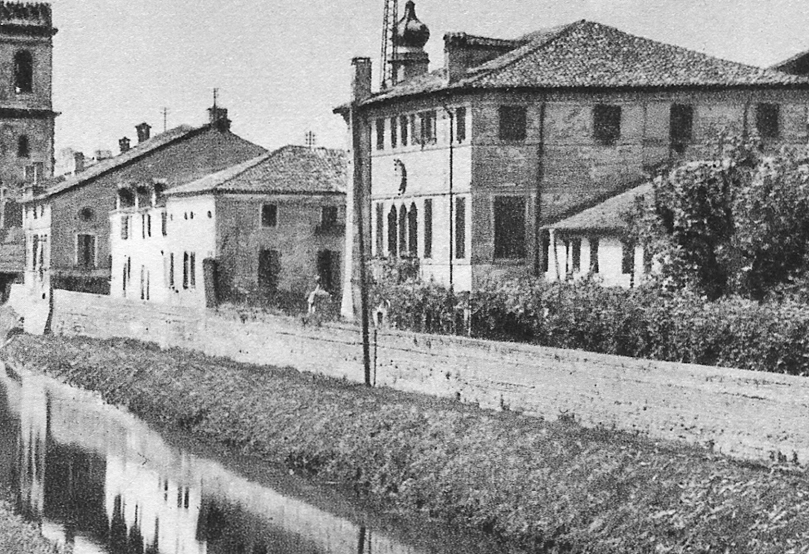
Passing through via Monache and reaching the bank of the Bisatto canal , you retrace part of the history and culture that have characterized Este and our territory since the beginning of the 15th century. It is precisely in this period that, after the surrender to the Republic of Venice , the presence of Jewish bankers – coming from Padua – was requested within the Este walls, called to lend money on pledge in exchange for various concessions. Over time, however, the concessions, recognized by a municipal notarial deed, caused no small amount of dismay due to usury, so much so that the Bishop of Padua, Pietro Dandolo , ordered the withdrawal of the statement.
The policy undertaken by the bishop of Padua did not limit the Jewish community which, over the centuries, found refuge in Este, spreading through the city districts and along the embankment of the Bisatto and via Monache, next to the Porta Vecchia of the city walls, an obligatory transit point to reach Lombardy.
It was in this very space that, following a ducal bull of 1665 , the Jews were forced ” to live together in the houses of the Botti heirs, Sive Bonati, and in the adjacent houses of the Lunardi heirs located in the district of S. Martino, which were enclosed by a courtyard with only one entrance and all the holes facing the public road were blocked, creating the shape of a ghetto “.
In fact, with this statement, the Jewish community was segregated in a ghetto with only one entrance and no openings to the outside. The homes that housed the Jews of Este faced the two walled arches onto the bank of the Canal and were positioned inside the block, with no views of public streets.
This state of marginalization ended in 1770 when the Jewish community, grouped in ghettos of larger neighboring cities, was forced to move between Padua and Venice. The Atestine ghetto, after the Jews were expelled, was occupied by citizens of low social status, so much so that this part of the city is still remembered as the “ghetto of misery”. After the Second World War, from the 1950s to the 1960s, the Atestine people who lived in the ghetto abandoned it almost entirely, finding more decent housing with the construction of the new neighborhoods of “Pilastro” and “Meggiaro”.
Today, despite the passage of time, the air you breathe in these places is steeped in history, so much so that between the Canale Bisatto and the Atestine walls you can relive the flavor of the past.
