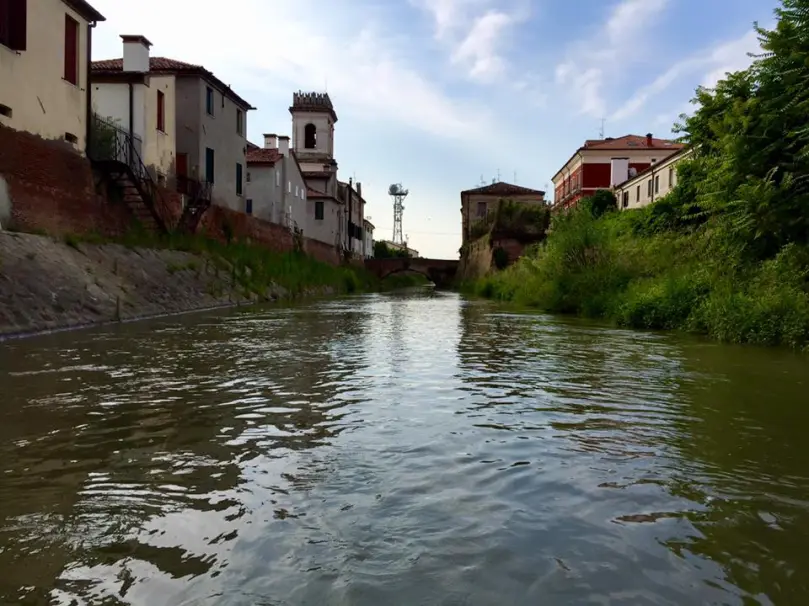
On Friday 19th June at 6pm at the Atrio di Ca’ Gentilini on Ponte delle Grazie (corner of via Mulini) in Este, WtC (Watch the City) will be inaugurated, a photographic exhibition that documents unusual aspects and particular characteristics of the Bisatto canal. Four young photographers have captured surprisingly evocative and meaningful images. The installation accompanies the visitor, as in a virtual immersion in the water, from one bank of the canal to the other, through the different languages and sensibilities of the authors.
“We tried to capture spaces and corners of Este that we all know, but that only a few are truly capable of grasping,” explains Arianna Ferraretto , photographer. “These shots represent an original proposal for the way of telling, perceiving and experiencing the city. Each one is the result of deep personal research, and in each one there is a piece of the author’s soul. They are photographs taken following the suggestions that Este gave us, and for this reason they will be able to move the viewer.”
The exhibition will remain open for the entire duration of WaterCity with the following hours: Friday, Saturday and Sunday from 5:30 pm to 8:00 pm. In July, on the occasion of the White Nights, the exhibition can also be visited on Thursdays from 9:00 pm to 11:00 pm.
Verum Ipsum Fact
Speech by Toni Zogno at the inauguration of the exhibition “WaterCity_the city and
the water” at the Ex-Pescheria, 13/06/2015 *
Verum ipsum factum
In the beautiful entrance door of the IUAV, in Tolentini, Carlo Scarpa wanted to impress the Vichian motto: VERUM IPSUM FACTUM or, “the truth is in the doing itself”, where the Latin terms VERUM and FACTUM are used interchangeably, or rather – as was taught in school – they “convert one into the other”.
As for Giambattista Vico, also for the Venetian architect the search for truth was identified with doing, and in that “doing” is contained the thinking – essential for the development of any idea or project – which is typical of the human mind.
The premise motivates La Medusa’s choice to support Water City, sharing the thought that WC was an opportunity for young people “under 35” of the city of Este to learn about the history of this territory and its transformations, read through water and the landscape that it has so strongly characterized.
This thought has materialized in a project – challenging and certainly imperfect – that in these days and until the end of July finds realization in a series of initiatives, including this exhibition, that concerns theatre, music, cinema, photography, installations, archaeology, architecture, itineraries and guided tours and more.
By building the project, we are all learning a lot of things; for example:
1 – this exhibition brings together several working groups and different skills, with the declared intention of “stitching” together the many pieces of information that usually remain confined to specific fields (archaeology, urban planning, architecture, historical research, photography, communication, etc.);
2 – “knowledge” is important, but it is equally important to share and transmit what you know, allowing everyone to develop a broader and more conscious vision of what we have inherited, of the reality in which we live and, ultimately, of the future we are building (or perhaps destroying…);
3 – if we show curiosity, interest and passion for what we do, we always have something to learn: you are not an architect or an artist, you can only learn to become one, at 20 or at 70, with a healthy exercise of intellectual honesty; the concept is taken up by K. Marx: “… there are no painters, but at most men who, among other things, also paint.”
4 – the internet and social networks are important tools, but they remain just tools: only if they are filled with content can they communicate ideas and projects of some use to the network community; otherwise they remain (virtual) places of (subjective) representation of one’s individuality and (unproductive) exchange of chatter.
The WC experience (and here I speak on behalf of the project coordinators) is an open construction site that we have conceived from the beginning as a “collective” experience.
This exhibition is in fact the result of the joint work of a group of young people: work that, trusting in the understanding of historians and scholars, has no claim to exhaustiveness or completeness: it is a “work in progress” open to the contribution of visitors.
In the exhibition you will find blank sheets of paper where you can leave comments, suggestions and criticisms and the availability of the young people who created it to collect suggestions and materials to improve it.
You will also find a first imperfect draft of the video animation – also “in progress” – which for the first time attempts to make visible the transformations of Este, from its origins to today, in a dynamic way.
Finally, taking advantage of the presence of some of our “Administrators of Public Things” and trying to ask ourselves what the developments of the WC Project could be, we allow ourselves to dream, keeping our feet on the ground:
A – it would be important for the Este Canal, now completely ignored by urban planning tools, to finally be considered a fundamental element for the redevelopment of our city; we do not need economic resources but rather broader and higher quality design visions, as well as more convinced political choices;
B – instead of being designed by roads, intersections, roundabouts, traffic lights, parking lots, subdivisions, concentrations of houses and warehouses; dotted with road signs and advertising, congested by traffic, made ugly by greedy and low-quality construction, this city could find its most “human” dimension in a project to make the Bisatto usable, which is, without fear of denial, one of its founding signs; of course, resources are needed, but part of them can be diverted in this direction and part sought among the funds made available by the calls for tenders;
C – it would be nice if the extraordinary heritage of archaeological sites buried in our territory were systematized and made accessible; not to mention the role that a museum so closely linked to the territory as the Museo Nazionale Atestino could also have for the economy of our city;
D – wait-and-see and immobility – furthermore seasoned with systematic complaints and criticism of the actions of others – are the most practiced city sports: it would be nice if they were replaced by a more proactive attitude and a more concrete and constructive commitment.
If you look closely, the guys from the WC project have started to do all this, starting from the recovery of their and our roots. I don’t think we can turn our backs on them, as this city and its canal have been done for too many years, but rather we should work to offer even the new
generations the possibility of imagining and building their future.
By committing ourselves, ourselves first, to create a better city…
Cinzia Tagliaferro, Enrico Fontana, Giorgio Gaino, Toni Zogno
* The exhibition at the Ex Pescheria was created by:
– Elisa Dalla Longa, Chiara Maratini, Ilaria Pantano (archaeology);
– Angelo Armonici, Arianna Ferraretto, Elena Sinigaglia, Thomas Tosato, Michele Vangelista (photography)
– Luca Canevarolo, Gianmarco Ferrarese, Mattia Paluan, Elena Rota (IUAV, architecture and urban planning)
– Sara Bertoldo, Gioia Borsatto, Lara Cusin, Chiara Silvestri, Riccardo Visentin (IUAV, design and multimedia processing)
The exhibition will remain open until July 26th with the following hours: Friday, Saturday and
Sunday from 5:30 pm to 8:00 pm. On the occasion of the White Nights, in July it will
also remain open on Thursdays from 9:00 pm to 11:00 pm.
Artist: Medusa Culture CenterCategories
Date: 20240920
Poster: abc